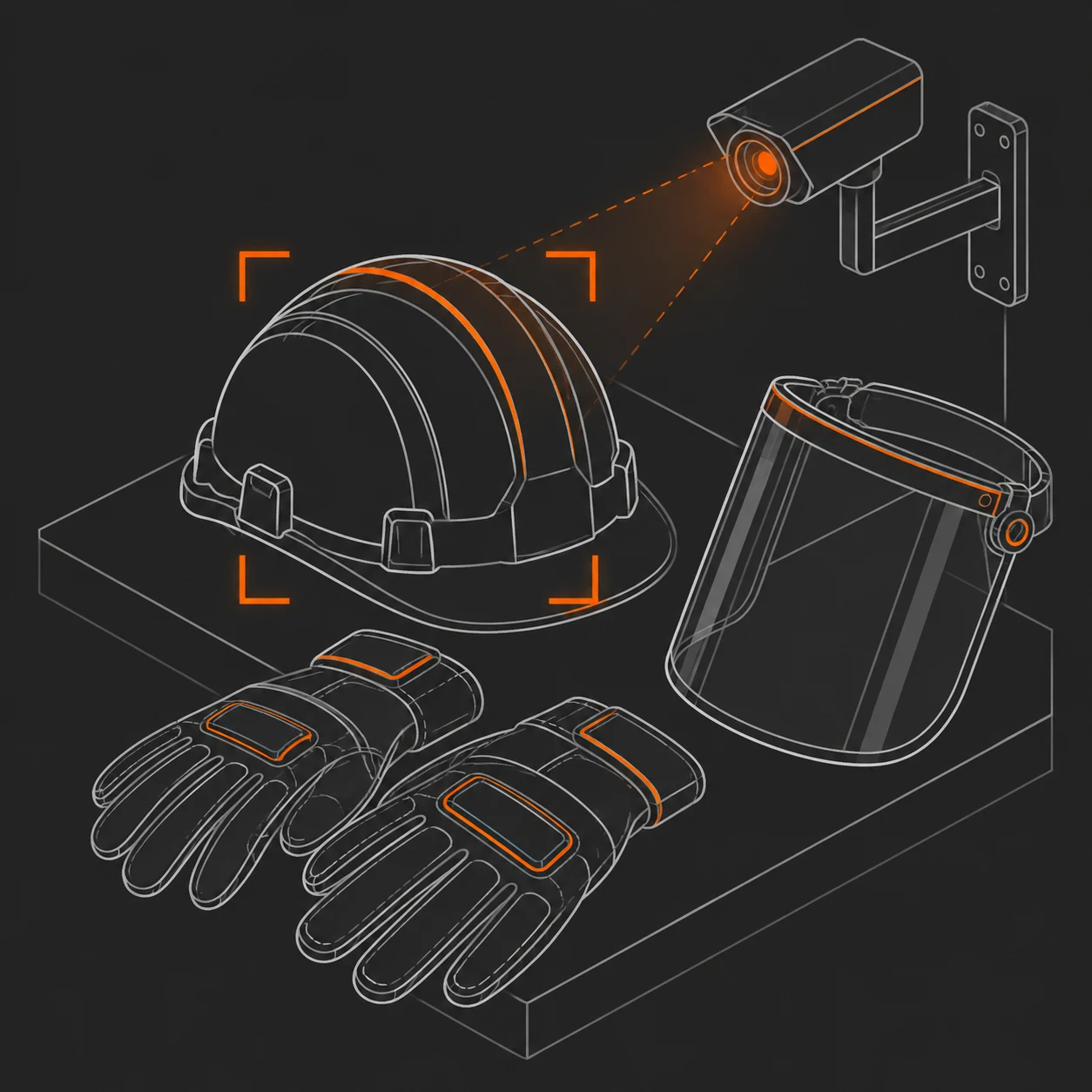
“We already have video analytics. It recognises helmets.”
Excellent. What happens after it recognises a helmet? Who receives the event? Who checks the violation? What does the responsible person do? How does management know whether the workplace has become safer?
If there are no answers to those questions, you have a detector. Not a safety-management system. A detector. A box around somebody’s head is not the digital transformation of occupational safety.
Adding AI does not mean solving the problem
Traditional CCTV automated the work of security teams: see what is happening, find a recording and reconstruct an incident. Manufacturers added detectors and invited everyone to consider the next round of modernisation complete.
It is a convenient logic. The camera stays. The archive stays. The interface stays. Bolt on a neural network and change the cover of the presentation.
But the safety specialist has a different job. They need to monitor the rules of a particular production area, understand where a risk has emerged, know who must intervene and see what changes after action is taken.
We add meaning to the video stream by turning it into events, actions and reporting. That is the difference between possessing AI and making it work for the enterprise.
A thousand alarms are not a measure of effectiveness
Imagine a working day. One person stays in a camera’s field of view for several minutes. The system reports the same thing repeatedly. Nearby, difficult backgrounds, occlusions and awkward viewing angles produce false detections.
The screen is busy. The counter keeps rising. The demonstration is impressive.
Meanwhile, the employee has acquired a new profession: alarm sorter. A safety specialist has become an attachment to an interface. Wonderful automation: we bought a system to give people more manual work.
Count useful events, false alarms, missed violations and the time people spend reviewing them. Then ask another question that glossy presentations tend to avoid: does the result help somebody make a decision?
A helmet by itself explains nothing
PPE monitoring starts with the enterprise’s rules. In which area is a helmet compulsory? When does the restriction apply? What is happening nearby? Which notification is required, and who needs it? What counts as a repeat of the same event?
The same applies to hazardous zones. “A person is in the image” is a fact. “A person is in a zone that is hazardous while the equipment is running” is an industrial task. Between the two sit a scenario, context and a connection to the production process.
Without that layer, the detector can only do what it was taught to do: find an object. A human has to work out everything else.
Duplicate suppression is not a mute button
Reducing alarm volume is easy. Lower the sensitivity. Send fewer notifications. Close the window altogether and enjoy the peace. Safety will not emerge from that silence.
The task is to remove repeated and incorrect events without losing genuine violations. That is why our approach combines zones, scenario conditions, duplicate suppression, object re-identification and additional checks by neural networks or multimodal large language models. Tools are selected for the task, not for a fashionable list of abbreviations.
An event needs video evidence. An operator needs a way to confirm or reject it. The implementation team needs feedback so it can investigate mistakes and improve the system. That is a process. Not a firework display of red boxes.
Show a working day, not a demo reel
To test video analytics, give it your site, your cameras and your real operations.
Before the pilot, agree which events it must find, how missed incidents will be checked, how false alarms will be counted, how quickly the responsible person receives the information and how many actions are needed to understand an event.
Do not test only the successful moments. Include an ordinary shift, difficult lighting, occlusions and the specifics of clothing and equipment. Keep configuration footage separate from independent validation material.
Then put the actual end user in front of the system. Not the presentation’s author. Not the salesperson. The customer’s responsible employee.
If they still spend hours watching video after the pilot, the question is not how modern the neural network is. The question is what work the system has actually done for them.
Buy the outcome of the process
Industrial video analytics connects cameras, models, scenarios, events, operator actions and enterprise systems. This is the thinking behind Platform 4.0 and our workplace-safety solutions. The purpose is to help the enterprise manage safety as a process.
We are not competing for the prettiest box around a person. We are competing on what happens after it.
Explore the case studies or read the FAQ on cameras, pilots and false alarms.